
What a market is: buyers, sellers and a price
See how a price is simply the last deal a buyer and a seller agreed on, and why it moves when one side gets more eager than the other.
WHAT A MARKET IS
A place where buyers meet sellers
A market is anywhere buyers and sellers meet to swap something for money. In trading that something is an asset: shares of a company, currencies, commodities like gold or oil, or crypto. A share (also called a stock) is a small piece of ownership of a company. Whoever holds it owns that slice, and can sell it on to someone else.
A fruit stall and a stock exchange do the same basic job: one person has something, another wants it, and they settle on a price. The exchange just does it millions of times a day, by computer, with strangers who never meet.
Last traded price
The price shown on a screen is usually the last traded price: the most recent level at which a buyer and a seller actually agreed and a trade happened. It is a record of the past, even if the past was one second ago. Nobody guarantees it, and it is not a calculation of what the asset is "really worth".
A screen shows 100. That means the latest trade happened at 100. The next one could be at 99 or 101, depending on who agrees with whom next.
Check yourself
Nima sees 100 next to a share on a trading screen. What does that number most likely tell him?
- The fair value that analysts calculated for the share
- The last price at which a buyer and a seller actually traded
- The price the company guarantees he can sell at
- The average price of the share over the past year
Show the answer
The last price at which a buyer and a seller actually traded
Right. It is the last deal that actually happened. It says nothing about fair value and guarantees nothing about the next trade.
WHO RUNS IT
Exchanges, matching engines and brokers
An exchange runs a central computer called a matching engine. It collects buy and sell orders and pairs them by price first, then time: the best price wins, and at the same price whoever arrived first goes first. Some markets have no central book: deals happen directly between dealers, which is called over-the-counter (OTC). Most individuals never talk to an exchange themselves. They reach it through a broker, a firm that passes their orders on.
You tap "buy" in an app. The app belongs to a broker, the broker sends your order to an exchange, and the exchange's matching engine looks for a seller whose price fits.
How one trade happens
- You place an order
You say what you want: buy or sell, how many, and at what price or "at the best price now".
- Your broker passes it on
The broker checks you have the money or the shares, then sends the order to the market.
- The engine looks for a match
It compares your order with the ones already waiting, best price first, then earliest first.
- A trade prints
When a buy and a sell fit, they trade. That price becomes the new last traded price on every screen.
- Both sides are updated
The buyer now holds the shares and the seller holds the money. Neither needs to know who the other was.
Check yourself
When Sara buys 10 shares on an exchange, the company that issued them is the one selling them to her.
Show the answer
False
False. On an exchange she almost always buys from another market participant, someone who already held those shares and wanted to sell. Every trade has a buyer and a seller, and the company is not part of it.
WHY PRICES MOVE
It is about eagerness, not headcount
People say a price rose because there were "more buyers than sellers". That can't be literally true: every trade has exactly one buyer and one seller for each share. What the phrase really means is that buyers were more eager. They stopped waiting for a lower price and accepted what sellers were asking, again and again. Each of those trades printed a little higher. When sellers become the eager side and accept what buyers offer, trades print lower.
Buyers are bidding 98 and 99, sellers are asking 101 and 102. Nothing trades until one side gives in. If a buyer pays 101, and the next one pays 102, the price has risen, without the number of shares bought and sold ever being unequal.
Check yourself
For the last ten minutes, buyers have kept accepting whatever price sellers are asking. What tends to happen to the last traded price?
- It rises, because each trade happens at the sellers' higher price
- It falls, because sellers are getting rid of their shares
- It stays the same, because every trade has a buyer and a seller
- It stops updating until the number of buyers and sellers is equal
Show the answer
It rises, because each trade happens at the sellers' higher price
Right. When buyers keep paying the asking price, each trade prints at the sellers' level, and as the cheapest sellers are used up, the next ones ask more. The last price climbs.
Where the company's money comes from
Primary market
A company sells new shares for the first time, for example in an initial public offering (IPO). The money from these sales goes to the company, which can use it to grow.
Secondary market
Afterwards, people trade those existing shares among themselves on an exchange. The money goes from one trader to another. The company receives nothing from these trades, however many there are.
Check yourself
When does a company receive new money from its shares?
- Every time one of its shares is traded on the exchange
- When it first sells new shares, for example in an IPO
- Whenever its share price goes up
- When traders sell its shares at a loss
Show the answer
When it first sells new shares, for example in an IPO
Right. The company is paid only when it issues and sells new shares in the primary market. Later trades between investors move money between them, not to the company.
Two different activities
Trading
Holding for minutes, days or a few weeks, aiming to profit from price moves. Every decision is about what the price does next. This course is about how trading works.
Investing
Holding for years, for the growth or the income of the asset itself: a business's profits, interest, rent. Short-term swings matter much less. The Personal Finance course covers it.
Check yourself
Trading or investing? Sort each habit by how long the money stays in and why.
- Buys in the morning and sells before the close
- Holds a broad fund for 20 years for retirement
- Holds for three weeks hoping for a price jump
- Keeps shares for years for the company's growing profits
- Checks the chart every few minutes to decide when to exit
- Adds a little every month and rarely looks at the price
Show the answer
Trading: Buys in the morning and sells before the close, Holds for three weeks hoping for a price jump, Checks the chart every few minutes to decide when to exit
Investing: Holds a broad fund for 20 years for retirement, Keeps shares for years for the company's growing profits, Adds a little every month and rarely looks at the price
Step through it
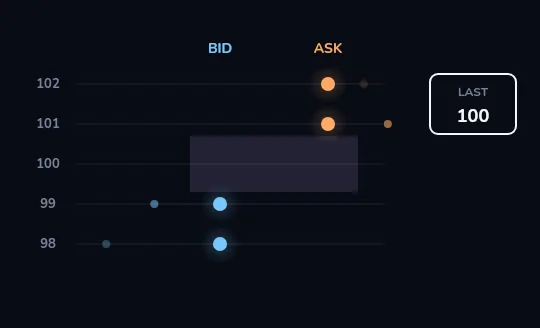
Bids at 98 and 99, asks at 101 and 102 Buyers on the left bid 98 and 99, and sellers on the right ask 101 and 102. The shaded band between 99 and 101 is the gap where nobody agrees, so nothing trades. The LAST box still shows 100, the price of an earlier deal.
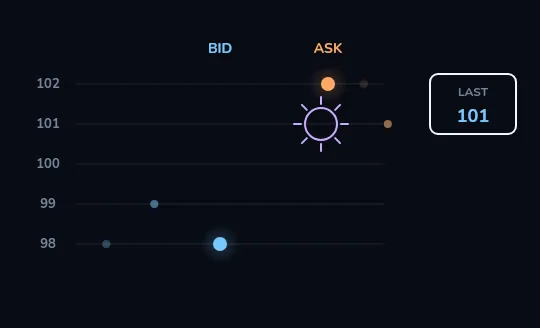
The 99 buyer accepts 101 The buyer who was bidding 99 stops waiting and moves up to 101, the cheapest seller's price. They meet in a flash, a trade happens, and LAST changes from 100 to 101. That is now the price everyone sees.
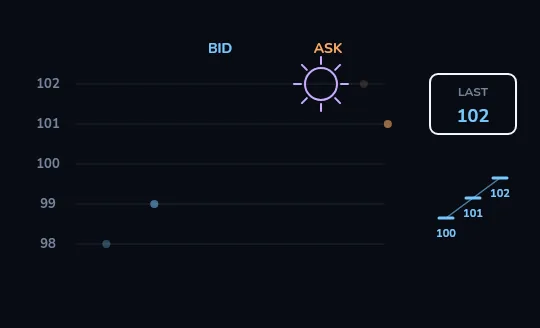
The 98 buyer pays 102 The 101 seller has sold and is gone, so the buyer who was at 98 has to go all the way to 102 to trade. LAST shows 102, and the small trail steps 100, 101, 102. Buyers paying what sellers ask, trade after trade: that is a rising price.
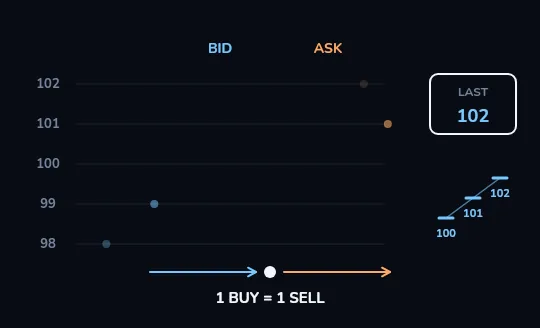
1 BUY = 1 SELL Along the bottom, one trade is drawn as a single dot with a blue arrow leading in from the buyer's side and an orange arrow leading out to the seller's side, labelled 1 BUY = 1 SELL. Every trade has a buyer and a seller. Your buy is somebody else's sell, and they may expect the opposite of what you expect.
Check yourself
In the first frame, bids were at 98 and 99 and asks at 101 and 102. Why did nothing trade?
- The exchange was closed
- The highest bid, 99, was below the lowest ask, 101, so no buyer and seller agreed
- There were more sellers than buyers
- The last price of 100 had to be reached first
Show the answer
The highest bid, 99, was below the lowest ask, 101, so no buyer and seller agreed
Right. A trade needs a buyer and a seller who agree on a price. Until someone moved, the best buyer offered 99 and the best seller wanted 101.
Lesson recap
- A market is where buyers and sellers swap an asset, such as a share, for money; a share is a small piece of a company.
- An exchange's matching engine pairs orders by price, then time. Most people reach it through a broker.
- The price on the screen is the last traded price: a record of the latest deal, not a guarantee or a fair value.
- Every trade has a buyer and a seller. Prices rise when buyers are the more eager side and keep paying what sellers ask.
- A company gets money only when it first sells new shares; later trades move money between traders.
- Education, not financial advice: this lesson explains mechanics, not what to buy or sell.