
Leverage and margin: small moves, big results
See how borrowing multiplies every gain and every loss by the same number, what a margin call is, and how fast a leveraged account can be wiped out.
Leverage
Controlling a position larger than your own money by borrowing the rest from the broker. It is written as a ratio: at 10:1 (or 10×), every 1 of yours controls 10. The total size of the position is called your exposure: it is what the market's moves are applied to.
With 1,000 of your own and 10:1 leverage, your exposure is 10,000. The other 9,000 is borrowed.
Margin
Your own money set aside as a deposit while you hold a leveraged position. It is not a fee; it is the part of the position that is yours, and it is the part that absorbs every loss first.
To open a 10,000 position at 10:1, the broker locks 1,000 of your account as margin.
Check yourself
Arash puts up 1,000 of margin at 10:1 leverage. How big is his position?
- 100
- 1,000
- 10,000
- 11,000
Show the answer
10,000
Right. 1,000 × 10 = 10,000 of exposure: his 1,000 plus 9,000 borrowed.
Margin (your money)            1,000
Leverage                        10:1
Exposure                      10,000

Price +5%    10,000 × 5%  =   +500   on 1,000 = +50%
Price −5%    10,000 × 5%  =   −500   on 1,000 = −50%
Price −10% 10,000 × 10% = −1,000 on 1,000 = −100%The market moved 5%. Your money moved 50%.
A 10% fall leaves 0.Gains and losses are worked out on the full 10,000 but come out of your 1,000. That is the whole trick of leverage, in both directions: every move is multiplied by 10 before it reaches you.
Check yourself
Arash's 10,000 position, bought with 1,000 of margin, falls 5%. What happens to his 1,000?
- It loses 50, which is 5%
- It loses 500, which is half of it
- Nothing, because the loss comes out of the borrowed part
- It loses all of it
Show the answer
It loses 500, which is half of it
Right. 5% of 10,000 is 500, and it comes out of his 1,000: half his money gone on a 5% move.
Step through it

1,000 of your own money A small blue block labelled 1,000 sits alone, marked MARGIN. It stands for the 1,000 of your own money you put up as a deposit. Nothing is borrowed yet.
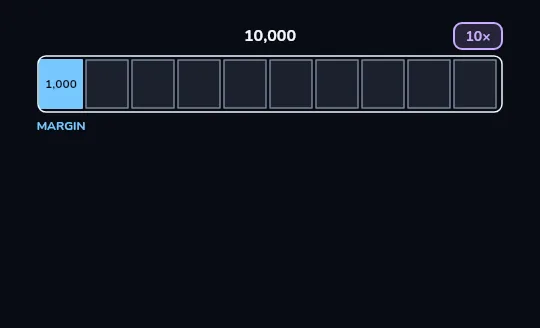
10× turns 1,000 into a 10,000 position The margin block becomes the first of ten cells in one wide outlined bar, labelled 10,000, with a lilac 10× tag. Only the first cell, the blue 1,000, is yours; the other nine dark cells, 9,000 in all, are borrowed from the broker.
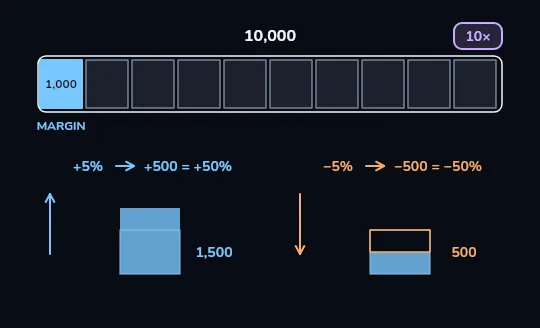
±5% on the market is ±50% on you Two readouts appear under the bar. On the left, a blue up arrow: +5% → +500 = +50%, and your block grows to 1,500. On the right, an orange down arrow: −5% → −500 = −50%, and your block drains to 500. Leverage multiplies both ways.
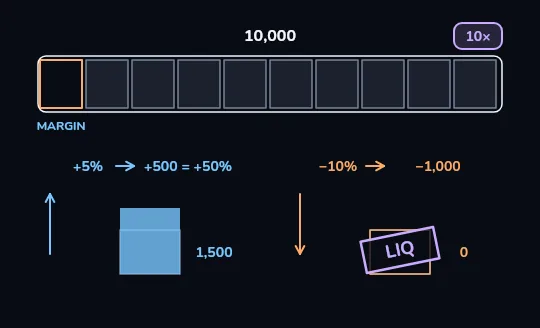
−10% wipes out the margin: LIQ The loss side now reads −10% → −1,000. Your block drops to 0 with a lilac LIQ stamp on it, and the margin cell in the top bar is empty. A 10% fall has taken the whole 1,000, and the broker closes (liquidates) the position. At 100 to 1, a 1% move would do the same.
The wipe-out rule of thumb
- At leverage L, a move of about 1/L against you wipes out the margin.
- 10:1 → about a 10% move.
- 50:1 → about a 2% move.
- 100:1 → about a 1% move, which many markets can make in an ordinary day.
- In practice the broker closes you out a little before that, when the margin falls below its required level.
Check yourself
An app offers Parisa 100:1 leverage. Roughly what move against her would wipe out her margin?
- About 1%
- About 10%
- About 50%
- About 100%
Show the answer
About 1%
Right. At 100:1, a 1% move on the exposure equals 100% of the margin. Prices move 1% all the time.
WHEN THE BROKER STEPS IN
Margin call and liquidation
The broker requires your margin to stay above a minimum, the maintenance margin. When losses eat it below that level, you get a margin call: add more money, or the broker closes the position automatically (liquidation). It does this to protect its loan, not you, and it usually happens at the worst moment: right after a sharp move against you, locking the loss in.
Arash's 1,000 margin has shrunk to 300 after a 7% fall. If the broker's minimum is higher than that, it asks him for more money or sells his position, whether or not the price would have recovered later.
Check yourself
What is a margin call?
- A call from the broker offering more leverage because you are doing well
- The broker demanding more money, or closing the position, because losses brought the margin below its required level
- The fee charged for opening a leveraged position
- A guarantee that the broker will cover losses larger than your deposit
Show the answer
The broker demanding more money, or closing the position, because losses brought the margin below its required level
Right. When the margin falls below the maintenance level, the broker asks for more money or liquidates the position.
Check yourself
When you size a leveraged trade with lesson 7's formula, you should work from the 10,000 exposure, not the 1,000 margin.
Show the answer
True
True. The market's moves apply to the whole 10,000, so that is what your stop-loss and your 1% risk have to be measured against. Sizing from the margin hides nine-tenths of the position.
Lesson recap
- Leverage controls a position larger than your money by borrowing; margin is your own deposit. 1,000 at 10:1 = 10,000 of exposure.
- Leverage multiplies gains and losses by the same factor: ±5% on the market is ±50% on your 1,000.
- A move of about 1/L against you wipes out the margin: 10% at 10:1, 1% at 100:1.
- A margin call means add money or be liquidated; gaps can push losses past the deposit, and overnight financing costs extra.
- Size positions on the full exposure, and treat very high leverage offers as a warning sign.