
The cell: your smallest living part
What a cell is, the few parts almost every cell has, and what a cell does with food and oxygen to get energy.
THE BUILDING BLOCK
The smallest thing that is alive on its own
Every living thing is made of cells. A cell is the smallest unit that can stay alive by itself: it takes things in, uses them, makes more of itself and gets rid of waste. You are built from tens of trillions of them (estimates for an adult are roughly 30 to 37 trillion). Most are far too small to see: a red blood cell is about 7 to 8 micrometres across, less than a hundredth of a millimetre.
Line up about 130 red blood cells side by side and you'd have roughly one millimetre. Yet some nerve cells are long enough to run from the bottom of your spine to your foot, up to about a metre.
Three parts almost every cell has
- Membrane: a thin, oily skin around the cell that decides what gets in and what gets out.
- Cytoplasm: the jelly inside, where most of the cell's work happens.
- Nucleus: the control centre, holding the DNA, the instructions for building the proteins the cell needs.
- One famous exception: a mature red blood cell has no nucleus. It gives it up to make more room for haemoglobin, the molecule that carries oxygen.
Check yourself
A mature red blood cell has a nucleus with DNA, just like a skin cell or a muscle cell.
Show the answer
False
False. Mature red blood cells lose their nucleus as they develop. That frees up space for more haemoglobin, so each one can carry more oxygen. It's one of the few cell types in your body without a nucleus.
Step through it
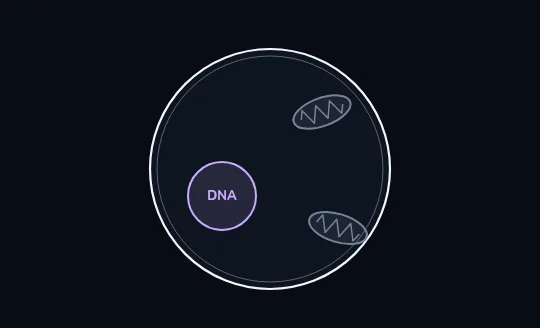
One cell, at rest This is one cell. The ring around it is the membrane, and the round centre marked DNA is the nucleus, holding the cell's instructions. The two small ovals with folded insides are mitochondria, still dim because nothing has reached them yet.
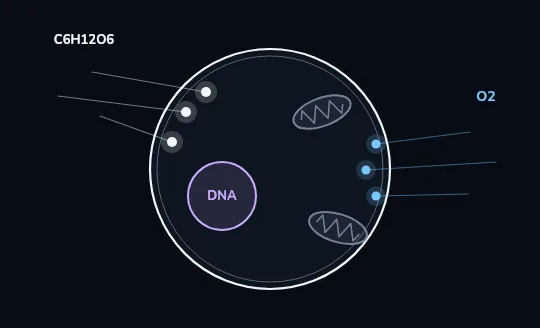
Glucose and oxygen come in Food arrives as glucose, the sugar labelled C6H12O6 (white dots), and oxygen arrives as O2 (blue dots). Both slip in through the membrane from outside, carried to the cell by your blood.
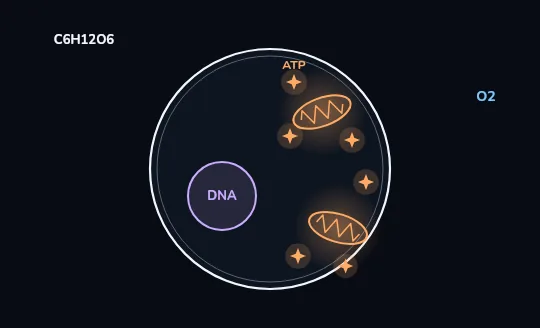
The mitochondria light up and make ATP The glucose and oxygen reach the mitochondria, which glow as they combine the two. The energy that comes out is packed into small, ready-to-use packets called ATP, shown as the orange sparks popping out around them.
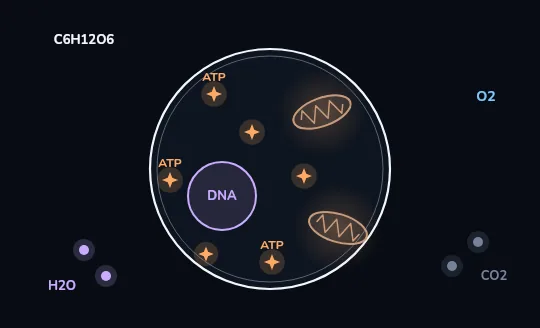
ATP spreads, the leftovers leave The ATP spreads through the whole cell, wherever work needs doing. The leftovers, carbon dioxide (CO2, grey dots) and water (H2O, lilac dots), leave through the membrane; your blood carries the CO2 to your lungs, which breathe it out.
Check yourself
From the frames you just stepped through: which part of the cell turned glucose and oxygen into usable energy?
- The membrane
- The nucleus
- The mitochondria
- The cytoplasm around the nucleus
Show the answer
The mitochondria
Right. The mitochondria combine glucose with oxygen and pack the energy as ATP, which the rest of the cell then spends.
Cellular respiration
The chemical process in which a cell breaks down food with oxygen to release energy. In words: glucose + oxygen → carbon dioxide + water + energy, and the energy is stored in a molecule called ATP. Most of it happens inside the mitochondria.
When you climb stairs, your leg muscle cells run this reaction much faster, which is why you breathe harder: they need more oxygen in and have more carbon dioxide to get rid of.
A charging station that fills small batteries
Think of each mitochondrion as a charging station. Glucose and oxygen go in; out come small charged batteries, the ATP, which get carried to wherever the cell needs power: a muscle fibre pulling, a nerve cell firing, a gland making a hormone. Once a battery is spent, it goes back to be recharged. Where the analogy breaks: nothing burns with a flame. The energy is released in many small, controlled steps, which is why your cells don't catch fire, though they do give off some heat.
Check yourself
After a cell has made energy from glucose and oxygen, what does it give off as waste?
- Oxygen and glucose
- Carbon dioxide and water
- ATP and DNA
- Nothing: the food turns completely into energy
Show the answer
Carbon dioxide and water
Right. Carbon dioxide and water are the leftovers. The CO2 travels in your blood to your lungs, and you breathe it out.
SAME BOOK, DIFFERENT PAGES
About 200 kinds of cell, one set of instructions
Your body has a couple of hundred kinds of cell (the usual round figure is about 200): muscle cells that pull, nerve cells that carry signals, skin cells that form a barrier, fat cells that store energy, and many more. Yet almost every one of them carries the same DNA. What makes them different is which instructions each one uses. A muscle cell reads the pages for pulling; a nerve cell reads the pages for signalling.
It's like one huge cookbook given to every cook in a restaurant. The pastry chef and the grill cook own identical books; they just open different chapters.
Check yourself
A muscle cell and a nerve cell from the same person carry almost the same DNA, yet look and work nothing alike. Why?
- Each type of cell uses different parts of the same instructions
- Muscle cells have DNA and nerve cells don't
- They come from food the person ate at different times
- The nerve cell's DNA was copied wrongly
Show the answer
Each type of cell uses different parts of the same instructions
Right. Same instruction book, different chapters switched on. That's how one set of DNA builds about 200 kinds of cell.
Check yourself
Sort each item by what happens to it in a working cell
- Glucose
- Oxygen
- ATP
- Carbon dioxide
- Water from the reaction
Show the answer
Comes in: Glucose, Oxygen
Made and used inside: ATP
Goes out as waste: Carbon dioxide, Water from the reaction
Lesson recap
- The cell is the smallest unit that is alive on its own; you're made of tens of trillions of them.
- Almost every cell has a membrane (what gets in and out), cytoplasm (where the work happens) and a nucleus with DNA (the instructions). Mature red blood cells are the exception: no nucleus.
- Mitochondria combine glucose and oxygen to release energy, packed as ATP. Carbon dioxide and water are the leftovers.
- That one reaction is why you eat and breathe: food and oxygen are delivered to your cells, and CO2 is carried away.
- About 200 kinds of cell share the same DNA; they differ in which instructions they use.