
The immune system: defence and memory
The barriers that keep germs out, the fast general response when they get in, and the slower targeted one that remembers them, which is how vaccines work.
Three layers of defence
- Barriers keep most germs out: your skin, sticky mucus and tiny hairs in your airways, stomach acid, and tears and saliva that contain germ-killing enzymes.
- The fast, general response (minutes to hours): white blood cells rush to any invader and swallow it. It works the same way whatever the germ is. This is called innate immunity.
- The slow, targeted response (days): special white blood cells build weapons for one particular germ, and remember it afterwards. This is called adaptive immunity.
- Immune cells gather in lymph nodes, small lumps in places like your neck and armpits. That's why they can swell during an infection.
Check yourself
A small cut on Leila's finger turns red, warm and a bit swollen the next day. What is that, most likely?
- A sign the germs have won
- Antibodies leaking out of the cut
- Inflammation: widened vessels bringing more blood and white cells to the spot
- The skin growing back too fast
Show the answer
Inflammation: widened vessels bringing more blood and white cells to the spot
Right. That's inflammation, part of the fast response. Vessels near the cut widen, bringing more blood and white blood cells, which is what makes it red, warm and swollen.
Step through it
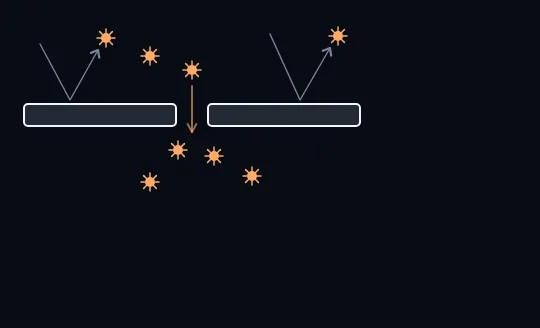
Skin keeps germs out, until a cut The two bars are a patch of skin, and the orange spiky dots are germs. Most of them bounce off the unbroken skin, as the grey arrows show. But here there's a gap, a cut, and a few germs slip straight through it into the tissue underneath.
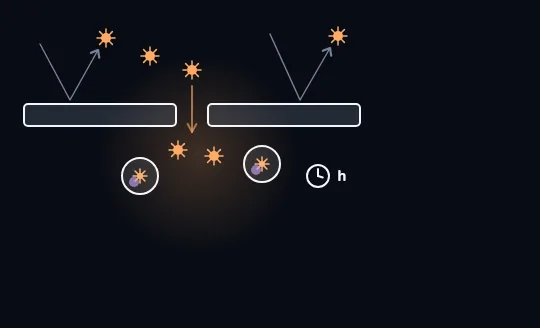
White blood cells swallow the invaders Within hours (the clock marked h), white blood cells, the large white circles, reach the cut and swallow germs whole; you can see a germ inside each one. The warm glow around the cut is inflammation: nearby vessels widen and bring more blood and more cells, which is why a cut turns red, warm and swollen.
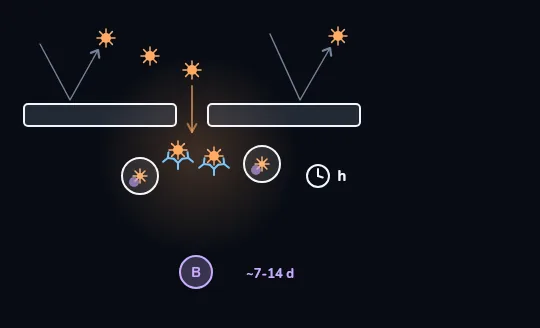
B cells make antibodies for this germ A B cell (the lilac circle marked B) has made antibodies, the small blue Y shapes, and they lock onto the germs still loose in the tissue, marking them for destruction. They fit only this one germ. The first time your body meets it, building up this targeted answer takes roughly one to two weeks, marked ~7-14 d.
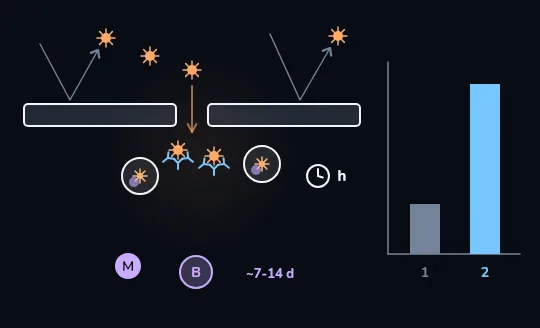
Memory: the second answer is faster and bigger A memory cell, the lilac dot marked M, stays behind after the germs are cleared. The bars compare two meetings with the same germ: the first response (1) is small and slow, while the second (2) is much bigger and comes much faster, often before you feel ill at all. Vaccines build this same memory without you having to get the disease.
Check yourself
What do antibodies actually do?
- Lock onto one specific germ and mark it for destruction
- Swallow any germ they meet, whatever it is
- Raise your temperature to cook the germs
- Seal the cut in the skin
Show the answer
Lock onto one specific germ and mark it for destruction
Right. Each antibody fits one particular germ, like a key in one lock. Once they're stuck on, the germ is easier for other immune cells to find and destroy.
MEMORY AND VACCINES
Your immune system remembers, and vaccines use that
After an infection, some of the cells that fought it stay on as memory cells, sometimes for many years. The next time the same germ shows up, they recognise it at once, and the targeted response starts in days or less instead of a week or two. A vaccine shows your immune system a harmless version or a piece of a germ, so it builds that memory without you going through the disease. The WHO counts vaccines among the most effective public-health tools there are.
Someone who has had chickenpox usually doesn't catch it again: memory cells deal with the virus before it can make them ill. A vaccine gives a similar memory without the illness.
A vaccine is a wanted poster
Imagine a town that has never seen a particular thief. The first time he comes, it takes the guards a while to work out who he is and catch him. A vaccine is like handing the guards a wanted poster in advance: they learn the face without the town being robbed, so if he ever turns up, they recognise him at once. Where the analogy stops: a vaccine doesn't give you the disease. It carries only a harmless version or a piece of the germ, just enough to learn from.
Check yourself
Why is a second infection with the same germ usually much milder than the first?
- The germ gets weaker every time it infects someone
- The skin has grown thicker since the first time
- The body has run out of the cells the germ attacks
- Memory cells recognise it and launch a faster, stronger response
Show the answer
Memory cells recognise it and launch a faster, stronger response
Right. Memory cells left from the first time spot the germ quickly, so the targeted response starts in days or less and is much bigger, often before you feel ill.
The two responses side by side
Fast and general (innate)
Starts within minutes to hours. The same for any invader. White blood cells swallow germs; inflammation and sometimes fever, a controlled rise in temperature, help the defence. No memory.
Slow and targeted (adaptive)
Takes days, about one to two weeks the first time. B cells make antibodies for one germ; T cells coordinate and kill infected cells. Leaves memory, so next time is faster.
Check yourself
Antibiotics are a good treatment for a cold, since a cold is caused by a virus.
Show the answer
False
False. Antibiotics act on bacteria, not viruses, so they don't help a cold or flu. A doctor decides when they're needed; using them when they aren't helps bacteria become resistant to them.
Check yourself
Sort each defence into its layer
- Skin
- Stomach acid
- White cells swallowing germs
- Inflammation around a cut
- Antibodies for one germ
- Memory cells
Show the answer
Barrier: Skin, Stomach acid
Fast, general: White cells swallowing germs, Inflammation around a cut
Slow, targeted: Antibodies for one germ, Memory cells
Lesson recap
- Barriers such as skin, mucus, stomach acid and tears keep most germs out.
- The fast, general response starts within hours: white blood cells swallow invaders, and inflammation brings more blood and cells to the spot.
- The targeted response takes about one to two weeks the first time: B cells make antibodies that lock onto one particular germ.
- Memory cells stay afterwards, so the next response to the same germ is faster and stronger. Vaccines build that memory without the disease.
- Antibiotics act on bacteria, not viruses; an allergy is the immune system overreacting to something harmless.