
Lungs and breathing
How the diaphragm pulls air in, the path air takes to hundreds of millions of tiny air sacs, and how oxygen and carbon dioxide swap places there.
THE PATH OF AIR
From your nose to the smallest air sacs
Air goes in through the nose or mouth, down the throat and into the trachea, your windpipe, held open by rings of cartilage. The trachea splits into two bronchi, one for each lung. Those keep branching into smaller and smaller tubes, the bronchioles, which end in tiny air sacs called alveoli. On the way, the nose warms the air, adds moisture and filters out dust.
Run a finger down the front of your neck below the Adam's apple and you can feel the ridges of the trachea's cartilage rings.
Check yourself
Which order does air follow on its way into the lungs?
- Bronchi → trachea → alveoli → bronchioles
- Trachea → bronchioles → bronchi → alveoli
- Trachea → bronchi → bronchioles → alveoli
- Alveoli → bronchioles → bronchi → trachea
Show the answer
Trachea → bronchi → bronchioles → alveoli
Right. One windpipe, two bronchi, ever-smaller bronchioles, and finally the alveoli, where the exchange happens.
THE ENGINE OF BREATHING
The diaphragm does the pulling
Your lungs have no muscle of their own to suck air in. The work is done by the diaphragm, a dome-shaped sheet of muscle under the lungs, helped by muscles between the ribs. Breathing in: the diaphragm contracts and flattens, and the rib muscles lift the ribs up and out. The chest gets bigger, the pressure inside drops, and air flows in. Breathing out at rest is mostly passive: the muscles relax and the stretchy lungs spring back.
Put a hand on your belly and breathe in slowly. It pushes out because the flattening diaphragm presses down on everything below it.
Step through it
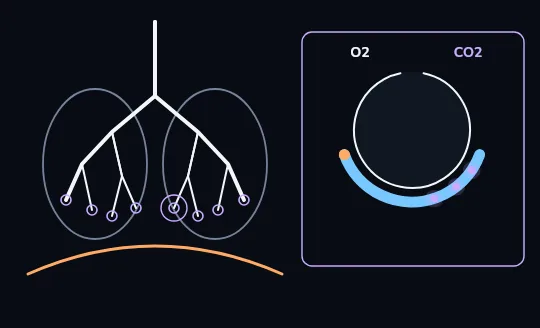
The airway tree at rest Air's path: the windpipe at the top, two bronchi, then smaller and smaller branches, each ending in a tiny air sac, inside the two lung outlines. The orange arc underneath is the diaphragm, domed up at rest. The panel on the right zooms in on one air sac, with a capillary wrapped under it.
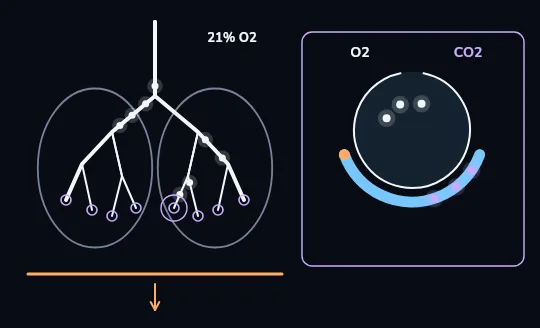
The diaphragm flattens, air rushes in The diaphragm contracts and flattens (the arrow points down), the lungs widen, and air streams down the windpipe into the air sacs. Fresh air is about 21% oxygen, the label 21% O2; in the zoom panel, oxygen dots now fill the air sac.
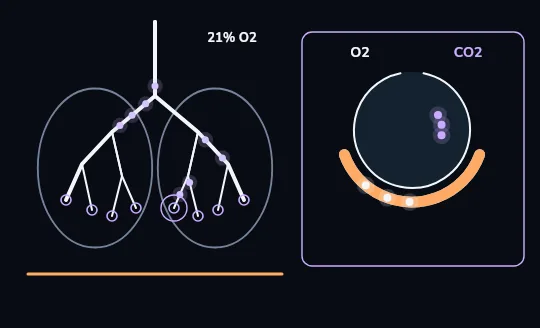
Oxygen in, carbon dioxide out In the zoom panel, oxygen (white dots) crosses from the air sac into the capillary, and the capillary turns from blue to orange as its blood picks the oxygen up. Carbon dioxide (lilac dots) crosses the other way, out of the blood and into the air sac, across a wall thinner than a cell.
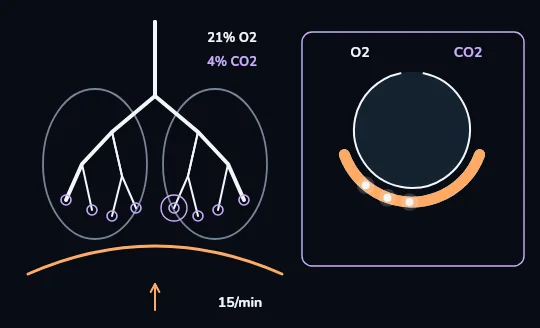
The diaphragm relaxes, used air goes out The diaphragm relaxes and domes back up (arrow up), the lungs spring back, and the used air goes out, now carrying about 4% carbon dioxide, the label 4% CO2. The capillary leaves orange, carrying its oxygen away. This happens about 15 times a minute at rest: 15/min.
Check yourself
What happens when the diaphragm contracts?
- It domes up, squeezing air out of the lungs
- It flattens, the chest gets bigger and air flows in
- It squeezes the lungs directly, like hands on a balloon
- Nothing happens to the air; it only moves the stomach
Show the answer
It flattens, the chest gets bigger and air flows in
Right. A flatter diaphragm means a bigger chest, lower pressure inside, and air flowing in to fill it.
A HUGE, THIN SURFACE
Hundreds of millions of air sacs
Your lungs hold roughly 300 to 500 million alveoli. Spread out, their combined surface is often quoted at around 50 to 100 m², roughly the floor of a small flat, packed into your chest. Each alveolus is wrapped in capillaries, and the barrier between the air and the blood is extremely thin. Gases cross it by diffusion: each one moves from where there's more of it to where there's less. The air sac has more oxygen than the blood arriving, so oxygen moves in; the blood has more carbon dioxide, so CO2 moves out.
No pump pushes the gases across. The difference in amounts on each side is enough, the way a drop of ink spreads through a glass of water on its own.
Breathing in numbers (typical healthy adult at rest)
- Air breathed in: about 21% oxygen and 0.04% carbon dioxide.
- Air breathed out: about 16% oxygen and about 4% carbon dioxide. Most of it, in and out, is nitrogen.
- So you use only part of the oxygen in each breath, which is why rescue breaths can help someone who isn't breathing.
- About 12 to 20 breaths a minute, roughly half a litre per quiet breath.
Check yourself
The air you breathe out has no oxygen left in it; it's all carbon dioxide.
Show the answer
False
False. Breathed-out air is still about 16% oxygen and only about 4% carbon dioxide; most of it is nitrogen, just as on the way in. Your body takes only part of the oxygen from each breath.
WHAT MAKES YOU GASP
Carbon dioxide drives the urge to breathe
You might expect the urge to breathe to come from running low on oxygen. Mostly, it doesn't. Sensors in your brainstem watch the level of carbon dioxide in your blood. As CO2 builds up, they drive you to breathe faster and deeper. That's why holding your breath gets uncomfortable so quickly: the rising CO2, not a shortage of oxygen, is what you feel.
When you run for a bus, your working muscles pour out CO2. The brainstem notices within seconds, and you find yourself breathing hard without deciding to.
Check yourself
Mina holds her breath under water. After about half a minute the urge to breathe becomes strong. What mostly drives that urge?
- Her lungs running completely out of oxygen
- Carbon dioxide building up in her blood
- Her diaphragm getting tired
- Water pressure on her chest
Show the answer
Carbon dioxide building up in her blood
Right. Sensors in the brainstem track rising CO2, and that's the main signal behind the urge to breathe.
Check yourself
Sort each event into breathing in or breathing out at rest
- The diaphragm contracts and flattens
- Rib muscles lift the ribs
- Pressure inside the chest drops
- The muscles relax
- The stretchy lungs spring back
- The diaphragm domes up again
Show the answer
Breathing in: The diaphragm contracts and flattens, Rib muscles lift the ribs, Pressure inside the chest drops
Breathing out at rest: The muscles relax, The stretchy lungs spring back, The diaphragm domes up again
Lesson recap
- Air travels nose or mouth → trachea → two bronchi → smaller bronchioles → hundreds of millions of alveoli.
- The lungs don't suck air in: the diaphragm contracts and flattens, the chest grows, and air flows in. Breathing out at rest is mostly the lungs springing back.
- In the alveoli, oxygen diffuses into the blood and carbon dioxide diffuses out, across a barrier thinner than a cell.
- Air in is about 21% oxygen; air out is still about 16% oxygen and about 4% CO2. At rest you breathe about 12 to 20 times a minute.
- Rising CO2, sensed in the brainstem, is the main driver of the urge to breathe. The oxygen is for your mitochondria; the CO2 is their waste.