
The kidneys: your blood's filters
How two fist-sized organs filter all your blood many times a day, keep what you need, and send the rest out as urine.
TWO FILTERS
Two bean-shaped organs, a million filters each
You have two kidneys, bean-shaped and each roughly the size of a fist, at the back of your abdomen just below the ribs, one on each side of the spine. At rest they receive about a fifth of all the blood your heart pumps. Each kidney holds roughly a million tiny filtering units called nephrons. Each nephron starts with a small ball of capillaries, the glomerulus, which leads into a long, looping tube.
Many people live healthy lives with just one kidney, for example after donating the other one: a single kidney can take on most of the work of two.
Check yourself
Blood reaches a kidney filter. Which of these normally stays in the blood instead of being filtered out?
- Water
- Salt
- Urea
- Red blood cells
Show the answer
Red blood cells
Right. Blood cells and large proteins are too big to pass through the filter, so they stay in the blood. Water, salts, glucose and urea are small enough to be pushed through.
Step through it
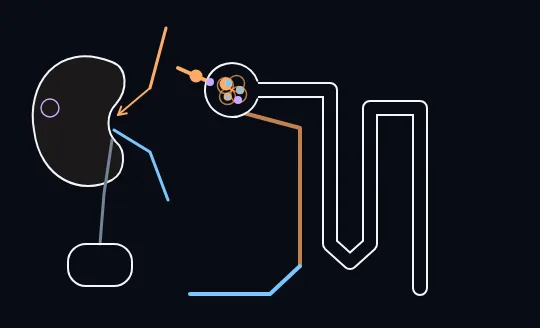
A kidney and one of its nephrons On the left is one kidney: an artery (orange) brings blood in, a vein (blue) takes it back out, and a thin tube runs down to the bladder, still empty. Real oxygen-poor blood is dark red, not blue. On the right is one of its roughly million nephrons: blood enters a tiny ball of capillaries, the glomerulus, which opens into a long looping tube with a blood vessel running alongside.
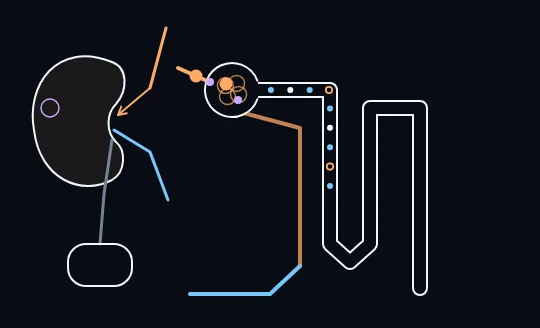
Filtration: small things are pushed out At the glomerulus, blood pressure pushes the small things out of the blood and into the tube: water (blue dots), glucose (white) and urea (orange rings). The blood cells (large orange discs) and proteins (lilac) are too big to fit through, so they stay in the blood. Across both kidneys, about 180 litres of fluid a day is filtered this way.
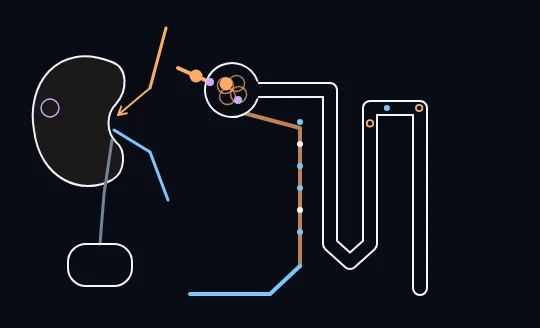
Reabsorption: taking back what you need Along the tube, the body takes back what it still needs: most of the blue water dots and all the white glucose dots move out of the tube into the blood vessel beside it, along with most of the salts. The orange urea rings stay in the tube, with only a little water, on their way out.
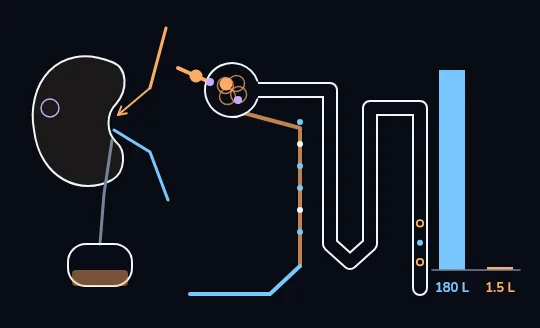
180 L filtered, 1.5 L of urine The two bars compare a whole day: about 180 litres filtered (tall blue bar) against only about 1.5 litres that leaves as urine (the tiny orange bar). The urea and a little water drain down the last tube, and the bladder on the left slowly fills.
Check yourself
Your kidneys filter about 180 litres of fluid a day. Roughly how much of it leaves as urine?
- About 90 litres, half of it
- About 1 to 2 litres
- About 18 litres, a tenth
- All 180 litres, over the day
Show the answer
About 1 to 2 litres
Right. Only about 1 to 2 litres a day. Almost everything filtered, nearly all the water, all the glucose, most salts, is taken back into the blood.
One nephron, start to finish
- Filter
In the glomerulus, pressure pushes water and small molecules (salts, glucose, urea) out of the blood. Cells and big proteins stay in.
- Take back
Along the tube, the body reabsorbs nearly all the water, all the glucose (in health) and most of the salts.
- Leave the rest
What stays in the tube is urine: urea, extra salts, extra water, and some traces of medicines.
- Store and empty
Urine flows down two thin tubes, the ureters, into the bladder, which stores it until you empty it.
Urea
The main waste product your kidneys remove. When your body breaks down protein, the leftover nitrogen would be harmful if it built up, so the liver turns it into urea, which dissolves in the blood and is filtered out by the kidneys into urine.
After a meal rich in protein, like chicken or lentils, your liver makes more urea over the following hours, and your kidneys have more of it to clear.
Check yourself
In a healthy person, the kidneys take back nearly all the glucose they filter out of the blood.
Show the answer
True
True. Glucose is fuel your cells need, so in health it's all reabsorbed along the tube and none is lost in urine. Glucose appearing in urine is a sign something isn't working normally, which is why doctors test for it.
The kidneys adjust how much water to keep
You drink a lot
There's more water in your blood than you need. The kidneys take less of it back, so you make more urine, and paler.
You sweat a lot, or drink little
Your body is short of water. A hormone from the brain, ADH, tells the kidneys to take more back, so you make less urine, and darker.
Check yourself
- Saturday: Sina sits at a desk all day and drinks plenty of water. He goes to the toilet often and his urine is pale.
- Monday: Sina helps a friend move house on a hot afternoon, sweats a lot and hardly drinks. He barely needs the toilet and his urine is dark yellow.
What best explains the difference between the two days?
- His kidneys worked harder on Saturday
- On Monday his kidneys took back more water to make up for what he lost in sweat
- On Monday his kidneys stopped filtering his blood
- Dark urine means the water he drank on Monday was dirty
Show the answer
On Monday his kidneys took back more water to make up for what he lost in sweat
Right. The filtering didn't stop; what changed was how much water was taken back. Short of water, his brain released more ADH, and the kidneys kept more of it, so less, darker urine was left.
Check yourself
Sort each item by what normally happens to it in a nephron
- Red blood cells
- Large proteins
- Glucose
- Most of the water
- Urea
- Extra salt
Show the answer
Never filtered: stays in blood: Red blood cells, Large proteins
Filtered, then taken back: Glucose, Most of the water
Leaves in urine: Urea, Extra salt
Lesson recap
- Two fist-sized kidneys hold roughly a million nephrons each, and receive about a fifth of the blood the heart pumps at rest.
- Filtration: pressure pushes water and small molecules out of the blood; cells and big proteins stay in.
- Reabsorption: of about 180 litres filtered a day, nearly all is taken back, so only about 1 to 2 litres leaves as urine.
- Urine carries away urea, extra salt and extra water. Urine is made from blood, not straight from what you drink.
- A hormone from the brain, ADH, sets how much water the kidneys keep: sweat a lot and you make less, darker urine.