
Mean, median and mode: three kinds of average
Three honest ways to say what is typical, and why one very large number can drag the mean far from where most people are.
THE MEAN
Add everything up, divide by how many
When people say "the average", they almost always mean the mean: add all the values together, then divide by how many values there are. It uses every number you have, which is its strength and, as you'll see, its weakness.
Five neighbours earn 30, 32, 35, 38 and 40 thousand a year. The total is 175; divided by 5, the mean is 35 thousand.
Median
The middle value once you line everything up from smallest to largest. Half the values sit below it and half above. With an even number of values there are two in the middle, so the median is halfway between them.
30, 32, 35, 38, 40: the median is 35. For 30, 32, 35, 38, 40, 400 the two middle values are 35 and 38, so the median is 36.5.
Check yourself
Four friends pay their shares of a lunch bill: 10, 12, 14 and 24. What is the mean amount they paid?
- 13
- 14
- 15
- 24
Show the answer
15
Right. 10 + 12 + 14 + 24 = 60, and 60 divided by 4 is 15. Notice the median here is 13 (halfway between 12 and 14): the one bigger bill already pulls the mean above it.
Step through it
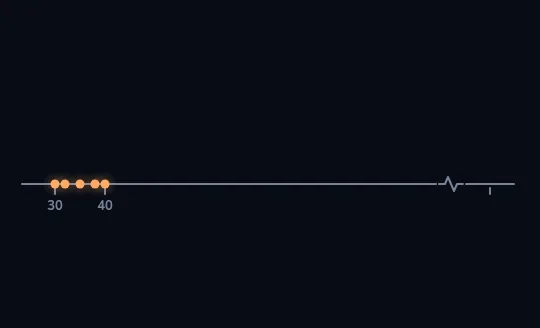
Five salaries on one street Five salaries on one street, in thousands a year: 30, 32, 35, 38 and 40, drawn as orange dots on a number line. They sit close together, all between 30 and 40; the zig-zag further right is a break in the line, leaving room for later.
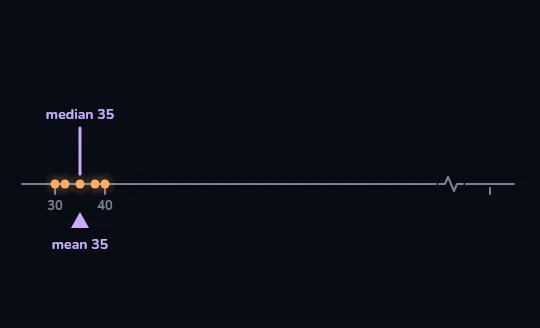
Mean and median agree at 35 Two lilac markers appear at the same spot: a line above the axis for the median, 35, and a triangle below it for the mean, also 35. When the values are spread evenly like this, both kinds of average land in the same place.
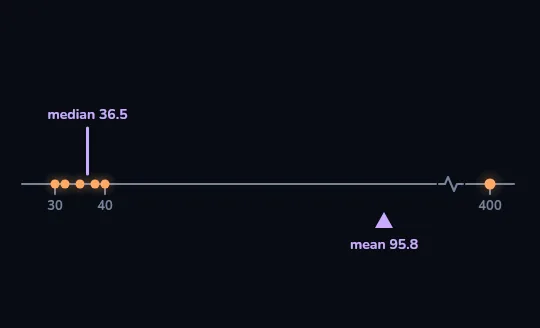
One high earner moves in A sixth neighbour earning 400 drops in, far to the right past a break in the line. The mean slides all the way to about 95.8 (575 divided by 6), while the median only shifts to 36.5, halfway between 35 and 38.
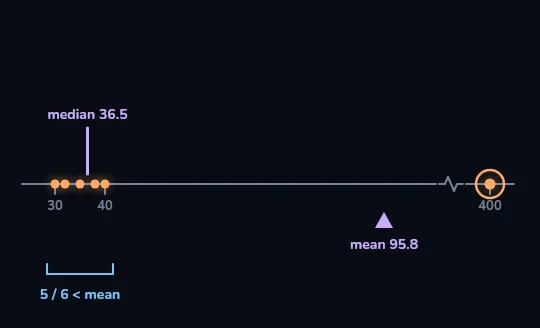
Five of six earn less than the average A bracket under the five low dots reads 5 / 6 < mean: five of the six people now earn far less than "the average", and the 400 dot is ringed as the outlier. One extreme value pulled the mean, not the middle.
Check yourself
The six salaries are now 30, 32, 35, 38, 40 and 400 thousand. Which figure is closer to what a typical resident of the street earns?
- The mean, about 95.8
- The median, 36.5
- The highest salary, 400
- Neither: with an outlier, no average means anything
Show the answer
The median, 36.5
Right. The median, 36.5, sits among the five ordinary salaries. The mean of about 96 is higher than what five of the six people earn.
Outliers and skewed data
Roughly symmetric
Values spread about evenly on both sides of the middle, like the first five salaries. Mean and median land close together, so it hardly matters which one you quote.
Skewed
A long tail on one side, often from a few outliers (values far from the rest). Incomes, house prices and wealth have a long tail of high values, so the mean sits above the median. When the two are far apart, ask which one the writer chose and why.
Check yourself
In any town, half the people earn more than the mean income.
Show the answer
False
False. Half above and half below is what the median means. Income is skewed, so the mean sits above the median, and usually well under half of people earn more than it. On our street, only one person of six did.
THE MODE
The value that shows up most often
The mode is simply the most common value. It is the only average that works for categories (the most popular colour, the most common answer) and it is handy for anything you can only pick from a fixed list. Data can have two modes (bimodal) or no mode at all if every value is different.
A shop sells shoes in sizes 38, 39, 39, 39, 40, 41, 42. The mode is 39, the size to stock most of. The mean is about 39.7, a size nobody wears.
Check yourself
Reza runs a shoe shop and wants to know which size to order the most of next season. Which average should he look at?
- The mean size sold
- The median size sold
- The mode, the size sold most often
Show the answer
The mode, the size sold most often
Right. He needs the size most customers actually buy, and that is the mode. A mean like 39.7 isn't even a size he can order.
Which average, when
- For money, waiting times and anything with a few huge values, the median describes the typical person better.
- The mean is right when totals matter: a total budget is the mean times the number of people.
- The mode is for categories and fixed choices: sizes, colours, the most common answer.
- "Average" in a headline doesn't say which one. If mean and median would differ a lot, it matters.
- Don't average averages from groups of different sizes: a class of 10 and a class of 40 don't count equally.
Check yourself
- In March, 20 ordinary flats sell in a small town. The median price is 200 thousand dollars and the mean is 210.
- In April, 20 similar flats sell again, plus three mansions at 3,000 thousand each. A report says "average house price jumps to about 574 thousand".
What most likely happened between March and April?
- Ordinary flats became almost three times as expensive in one month
- Three mansions pulled the mean up, while the median, what a typical flat sells for, barely moved
- The median jumped and the mean stayed the same
- The report must have added the numbers wrong
Show the answer
Three mansions pulled the mean up, while the median, what a typical flat sells for, barely moved
Exactly. Three huge values drag the mean far up, just like the 400 salary did. The median still sits among the ordinary flats, so it barely moves. A report quoting the median would have said prices were about flat.
Lesson recap
- The mean adds everything up and divides by how many: 30, 32, 35, 38, 40 gives 35.
- The median is the middle value in order; with an even count, it's halfway between the two middle ones.
- One outlier, a salary of 400, dragged the mean to about 96 while the median only moved to 36.5.
- Incomes and house prices are skewed, so their mean sits above their median; that's why statistics offices usually report the median.
- The mode is the most common value, the one to use for categories and sizes.